
Do you truly understand the strategy behind your company's compensation, or are you making decisions in the dark based on misleading averages? While salaries may appear competitive at first glance, a deeper dive into the data often reveals gender pay gaps, misalignments in key roles, and talent attrition. Discover how People Analytics and Actuaria’s Salary Benchmark allow you to identify exactly where to take action to maximize the impact of your budget.
Consider a company preparing for its annual salary review. Looking at its aggregate results, compensation appears to be aligned with the market. The initial conclusion might be that there are no major issues and that applying a uniform increase across the organization—or even no salary adjustment at all—would suffice.
However, when reviewing the data by position, the story begins to change. Some roles critical to operations are below market, while others are aligned or even above.
When comparing individuals with similar responsibilities, pay gaps between women and men also emerge. And when tenure is factored in, the company discovers that some employees with years of experience are receiving compensation very close to that of new hires.
None of these results explain the causes of the discrepancies on their own, but together they show that the situation was more complex than the first reading suggested. The conversation shifts from focusing solely on how much to increase to answering more important questions: Which positions require more attention? Which discrepancies should be addressed first? And where can the available salary budget generate the greatest impact?
People Analytics in Human Resources allows for an understanding of what is happening within an organization and where opportunities for improvement exist, based on the analysis of employee data. Its value lies not just in observing indicators, but in connecting them to gain a more complete view of talent management and to support decisions with greater precision.
Among its many applications, salary competitiveness analysis plays a key role: benchmarking internal compensation against market references helps identify gaps, establish priorities, and direct resources toward the positions and groups that require the most attention.
A company may conclude that its salary structure is aligned with the market and still maintain positions that have lost competitiveness, find pay gaps between women and men, or identify disparities associated with employee tenure.
Therefore, while general indicators are useful for observing the situation, they can be insufficient when they are the only reference for decision-making. Breaking down information by position, hierarchical level, and comparable groups allows for an understanding of what lies behind the results and identifies more precisely where it is best to take action.
The global analytics and consulting firm Gallup offers a good example of how a general figure can tell only part of the story. Its State of the Global Workplace 2026 report shows that global employee engagement fell from 23% in 2022 to 20% in 2025, a three-percentage-point reduction.
However, when breaking down the result by role, the source of this decline becomes clearer: among managers, the indicator dropped 9%, from 31% to 22%, while among those not in these roles, it decreased by only one percentage point. The general indicator warned of the deterioration; the detail revealed where it was concentrated.
The international consulting firm McKinsey reaches a related conclusion in its HR Monitor 2026, a study that collects responses from approximately 1,300 Human Resources professionals and 5,500 employees across ten countries. Its results show that compensation has a significant weight in the work experience: 52% of employees consider it one of the main factors for staying in their job.
The report also highlights the importance of equity and transparency, which reinforces the need to go beyond the company's general salary position and review differences between positions, hierarchical levels, and comparable groups to decide where to take action.
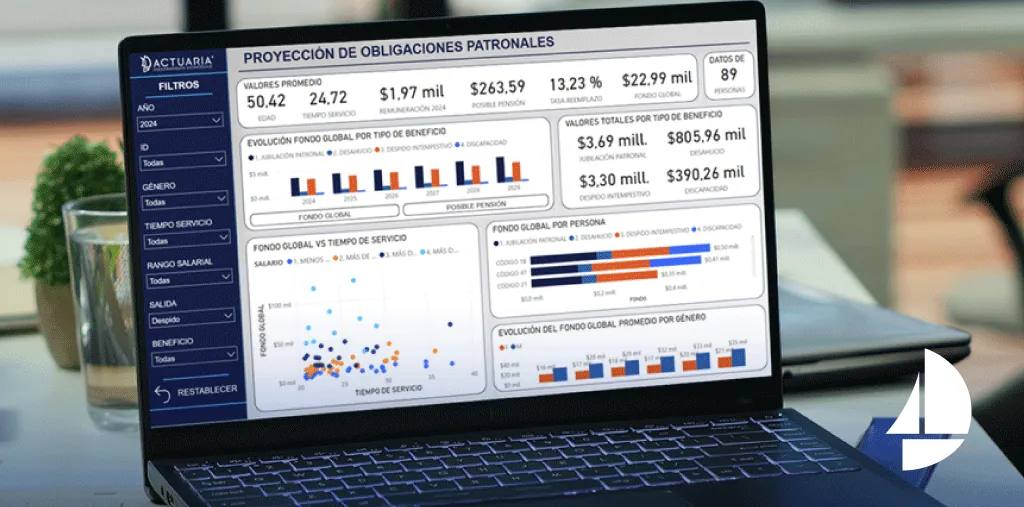
The Salary Benchmark by Actuaria integrates highly useful features into an interactive platform, which allows for comparing equivalent positions, analyzing results by organizational level, and identifying where the main gaps are concentrated.
With this information, every organization can establish priorities and build a compensation strategy in line with its culture, objectives, and financial capacity, defining what to adjust, in what order, and for what purpose.
Discover how this solution can help your organization strengthen its understanding of the salary structure and maintain a competitive compensation proposal.
Gallup (2026). State of the Global Workplace 2026.
McKinsey & Company (2026). HR Monitor 2026.