

Why does being insured lead us to take more risks?
In 1975, a few years after seat belt use became mandatory in automobiles, economist Sam Peltzman conducted a study with a counterintuitive primary finding: following the implementation of this protective measure, the number of minor accidents and pedestrian collisions surged. Peltzman explained this phenomenon through behavioral psychology as risk compensation. By shifting the threshold of danger perceived by drivers behind the wheel, the sense of security made them bolder and less cautious.
This behavior demonstrates that by introducing layers of protection—whether physical, health-related, or financial—we alter people's intrinsic perception of risk and, consequently, transform their behavior.
In the financial and actuarial fields, moral hazard occurs when a person or entity shifts to riskier behavior knowing that the consequences of a negative event will be borne by someone else. This manifests repeatedly across various sectors and environments.
With the rise of ransomware attacks, many companies purchased cybersecurity policies. However, research from the University of Pennsylvania Carey Law School, in conjunction with King's College London, documented that after obtaining coverage, several organizations began to neglect basic operational controls, such as the mandatory implementation of multi-factor authentication (MFA) or regular software patching.
By assuming that the insurer would pay the ransom or cover data restoration, the level of prevention dropped, leading to a drastic increase in claims that forced insurers to restructure their minimum underwriting requirements.
In Ecuador, the existence of the IESS General Occupational Risk Insurance provides comprehensive coverage for workplace accidents and occupational diseases. However, if a company perceives that risk is 100% externalized to social security, there is a risk of disincentivizing the provision of Personal Protective Equipment or ongoing occupational training programs.
To curb this distortion, Ecuadorian regulations apply the mechanism of Employer Liability with Benefit Surcharges. If an expert assessment proves that a workplace accident occurred due to negligence or a lack of preventive measures by the company, the IESS compensates the worker but charges the employer for the total cost of the benefits provided, while also applying the fines and financial surcharges established by law for failing to comply with workplace safety standards.
The psychological impact of full coverage also alters consumption in the healthcare sector. The RAND Health Insurance Experiment, one of the most extensive analytical studies in medical economics in history, demonstrated that users with 100% coverage health plans consumed 40% more health services and diagnostic tests than those with plans featuring 95% coinsurance. Notably, this increased resource consumption did not translate into a proportional improvement in the users' overall health status, reflecting overutilization driven solely by the absence of costs.
The goal of actuarial science is not to eliminate financial protection for the insured, but to design coverage structures that align incentives to avoid recklessness. The primary strategy lies in requiring the insured to maintain a reasonable level of financial responsibility, a concept known as "skin in the game."
This is achieved through the implementation of deductibles, coinsurance, and copayments, which directly modify user behavior without depriving them of support.
At Actuaria, we design these incentive schemes tailored to each organization: we define deductibles, coinsurance, and copayments that balance financial protection with the responsible use of benefits.
Let us analyze the following scenario within a corporate health program for 1,000 employees:
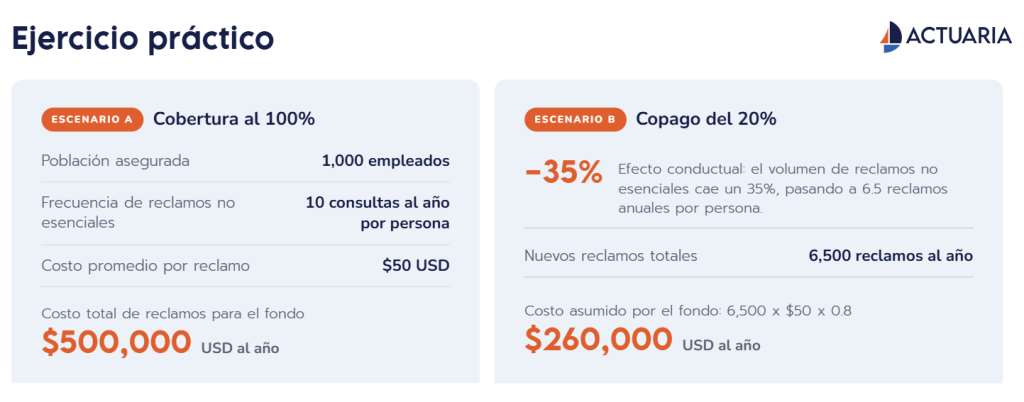
The total cost of claims decreases by 48%, reducing operational waste and preserving liquidity for real emergencies, which in turn prevents premiums from rising excessively.
A balanced actuarial design does not restrict coverage. It protects financial viability by incentivizing the responsible use of resources, resulting in a win-win scenario for everyone: users and companies alike.
At Actuaria, we help prepaid healthcare companies design pricing, deductible, and copayment models that balance member protection with business sustainability, supported by robust technical reserves and in compliance with current regulations. Discover our line of services focused on insurance companies:
Bibliography
https://www.econlib.org/what-the-peltzman-effect-is-and-isnt/
https://www.gob.ec/sites/default/files/regulations/2018-10/C.D.%20513.pdf
https://www.rand.org/pubs/research_briefs/RB9174.html
An expert will review your case and explain what it means for your company, with no obligation.
.jpg)