
We analyze the actuarial impact of updating mortality tables for the calculation of employer retirement benefits in Ecuador. This article examines how increased life expectancy raises labor liabilities and highlights the importance of companies evaluating these regulatory and demographic changes.
A mortality table used for more than two decades can have a significant impact on the current valuation of employer pension obligations in Ecuador. The evolution of life expectancy raises the need to analyze how a potential update to these parameters could modify companies' labor provisions and obligations.
Currently, the calculation of employer pensions uses the 2002 mortality table in effect in the country. Article 218 of the Labor Code refers only to a “table of coefficients”; the mathematical origin of these values is found in secondary regulations.
Specifically, Ministerial Agreement No. MDT-2015-0204 of the Ministry of Labor establishes in its methodology that these coefficients come from Resolution No. C.I. 141, issued by the Ecuadorian Social Security Institute (IESS) and published in Official Registry No. 650 on August 28, 2002. This resolution officializes the general mortality tables.
In practice, this means that Ecuadorian companies value their long-term labor obligations using mortality parameters established more than two decades ago.
It is important to note that the updating of these tables cannot be applied unilaterally by actuaries. As long as current regulations maintain the existing table as a reference, employer pension calculations must be performed using those parameters, even if more recent tables exist. Their replacement would require a regulatory update to establish such a change.
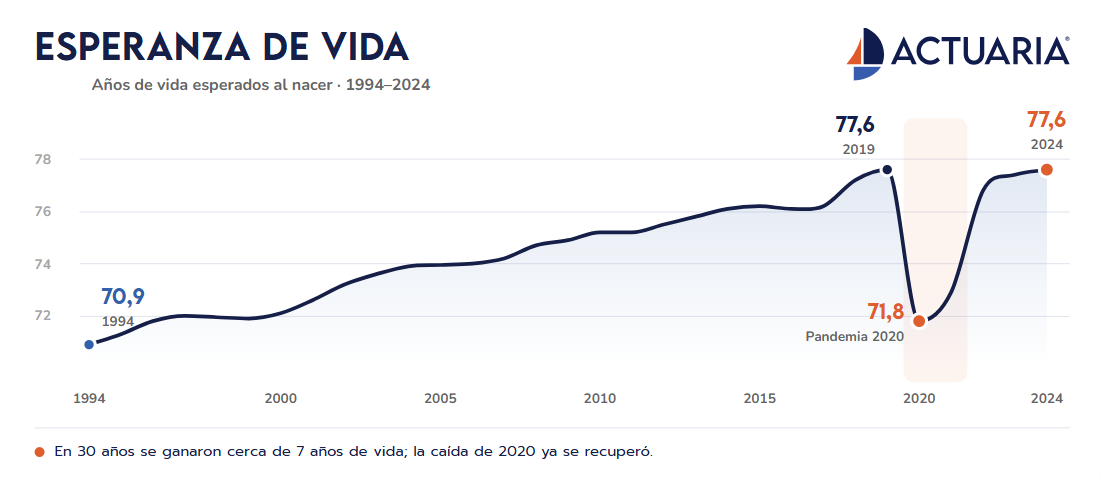
The country's demographic evolution shows a significant difference between the parameters currently used and the actual population reality. According to the country profile in the report Health in the Americas by the Pan American Health Organization (PAHO/WHO), life expectancy in Ecuador rose from 72.1 years in 2000 to 77.6 years in recent years, an increase of 5.5 years. The evolution of life expectancy can be seen in the following chart.
Added to this is the development of the so-called “IESS 2020 Mortality Table,” prepared by the same institution. A potential update to the tables used for calculating employer pensions could better reflect the changes observed in the population's longevity.
This phenomenon is part of a structural process known as demographic and epidemiological transition. Improvements in preventive medicine, the treatment of chronic diseases, and health infrastructure have contributed to a reduction in mortality and a progressive increase in life expectancy.
To visualize the effect that an update to actuarial parameters could have on the calculation of employer pensions in Ecuador, a practical case was developed comparing the current scenario, based on the IESS 2002 table, with an adjusted scenario using the IESS 2020 mortality table.
The following parameters were considered for the simulation:
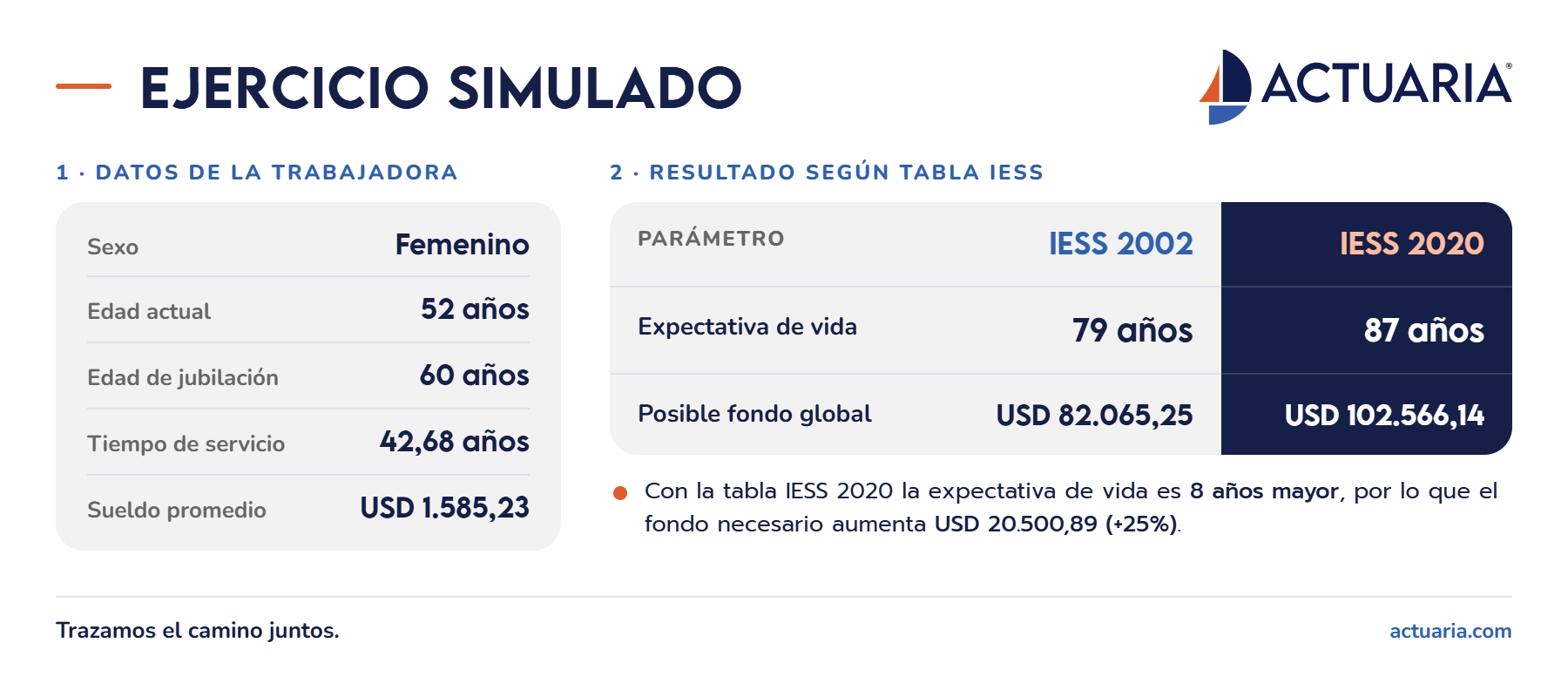
The exercise shows that a higher life expectancy can significantly increase the payment for employer pensions.
An update to mortality parameters can have a relevant impact on the valuation of employer pension obligations. As projected life expectancy increases, the period during which the company is expected to maintain its obligations to retirees may also increase. Therefore, any modification to actuarial assumptions must be analyzed considering its potential effects
Ecuador's demographic and actuarial evolution makes it essential for companies to evaluate different scenarios before any potential update to the tables used for calculating employer retirement benefits.
At Actuaria, we have a team of actuarial consultants prepared to assess your company's situation, simulate scenarios using updated mortality tables, and analyze the potential financial impact of these changes.
Anticipating these changes allows for the identification of potential variations in actuarial liabilities and enables more informed financial decision-making in the face of future regulatory and demographic shifts.
References: